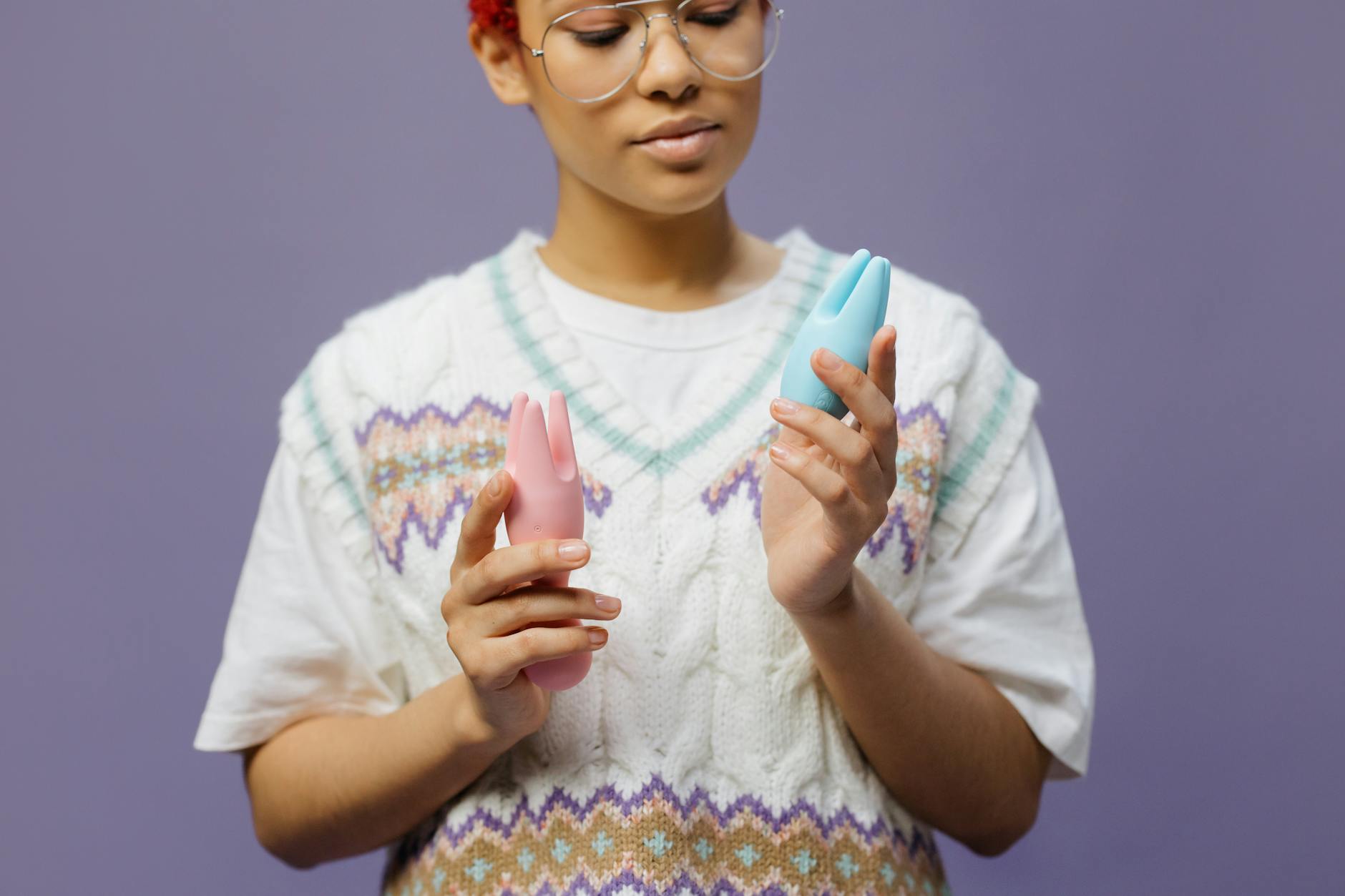
Why Lemon Vibrators Help When Arousal Takes Longer With a Partner
Here's the thing nobody tells you: the gap between how fast you get aroused and how fast your partner does is one of the most common friction points in long-term relationships. Not because either of you is broken. But because we're taught to treat arousal like it's a synchronized dance, when it's actually more like two people arriving at the party at different times.
One of you is ready in five minutes. The other needs twenty. What was working at the beginning of the relationship—when novelty and newness handled the gap—starts to feel like a mismatch. And that's where things get weird. They get resentful. You get self-conscious. Nobody's having fun.
I work with couples on this constantly. And what I've learned is that the right tool—a clitoral vibrator like the Lem—can entirely reframe the problem from "what's wrong with us" to "here's how we bridge the gap together."
The arousal timeline problem is more common than you think
Let's be real about the data first. Studies consistently show that people with vulvas take longer to reach peak arousal than people with penises. We're talking an average gap of 10-15 minutes. That's not negligible. That's half of most people's sexual encounters.
But here's what matters more: individual variation crushes gender variation. You might need five minutes. Your partner might need thirty. Someone else needs two minutes and their partner needs forty-five. There's no "right" timeline.
What actually matters is what happens in that gap. Do you use it? Resent it? Ignore it and hope it fixes itself?
Most couples do the third thing. They hope. And hoping is how you end up with quickies that leave one person frustrated and both people feeling disconnected.
Why the gap gets bigger as relationships age
When you're first together, the gap is invisible because both of you are primed just by proximity. You're not thinking about other things. Your nervous system isn't carrying the day's stress, the mortgage payment, or what you said to your mother-in-law.
Five years in, ten years in, twenty years in? You're managing a household. You're tired. You're managing other people's expectations. That five-minute arousal gap turns into twenty minutes because your brain is still at work, even if your body showed up.
This is completely normal. It's also completely solvable. But it requires a conversation you probably haven't had, and a tool you might not have considered.
What a clitoral vibrator actually does in this scenario
I recommend lemon vibrators and similar clitoral suckers to couples specifically because they do something that fingers, tongues, and penetration can't: they activate arousal independently of your emotional or cognitive state.
A lemon vibrator works through air-suction stimulation. This creates a physical response that doesn't require your brain to be fully online. You don't have to get out of your own head. You don't have to perform arousal. The vibrator does its job, and your body responds.
This matters because it separates two things we usually bundle together: the work of getting turned on, and the work of connecting with your partner.
When your partner uses a clitoral vibrator on you while you're still finding your way into arousal, they're actively involved in your pleasure. They're not waiting. You're not stalling. You're both moving toward the same place, just at different starting speeds.
How to introduce a lemon vibrator without making it weird
Honestly? This is the part most couples get wrong. They think about the vibrator as a Band-Aid for a problem. So they bring it in with apology energy: "I know I take too long," or "I'm sorry, I can't get there fast enough."
That's the wrong frame. Try this instead.
Pick a moment when you're not trying to have sex. Maybe you're in the kitchen. Maybe you're on the couch watching something. Say something like: "I've been thinking about us. I want to try something that might actually make things better for both of us. I read that couples use things like clitoral vibrators to bridge arousal gaps. You interested?"
That's it. No apology. No shame. Just an observation and a question.
If they're interested, great. If they're not ready, respect that. But at least the conversation is on the table.
When you do try it, start slow. Use it on yourself first so you know how it feels. Then let your partner use it on you. This isn't about replacing each other. It's about collaboration.
The emotional shift that happens when you use it together
This is the part that surprised almost every couple I've worked with.
When you both accept that you have different arousal timelines, and you use a tool specifically designed to help you meet in the middle, something shifts. The gap stops feeling like failure. It starts feeling like foreplay.
Your partner gets to watch you respond. You get to relax into your own arousal without performing. You're literally on the same team, trying to solve a shared problem.
That's intimacy. That's connection. That's what lasts.
Some couples find that once they've bridged the gap a few times, they can go back to other methods. Some couples find they love using clitoral vibrators and keep doing it. Either way, the anxiety is gone. The resentment fades. You remember why you wanted to be together in the first place.
What to expect the first few times
It might feel awkward. That's normal. You're doing something new. Your nervous system might take a minute to settle.
Go slow. Start on a lower setting. Take breaks. Talk to each other. "Does this feel good?" "What would you like to change?" These conversations aren't interruptions. They're the whole point.
Also: lube. Always. Even if you think you don't need it, use it anyway. A water-based lube makes everything feel better and smoother.
The first time you get to shared arousal without stress or resentment? You'll know something clicked. Hold onto that feeling. That's what you're building toward.
FAQ
How long does it actually take for arousal to sync up with a vibrator?
It depends. The first time? Maybe five to ten minutes of play before you're both ready. By the tenth time? Some couples report it's faster because they're less anxious. Others find that having the tool available just removes the pressure entirely, and things happen naturally. There's no timeline. That's the whole point.
Will using a vibrator make my partner feel like they're not enough?
Not if you frame it right. This isn't "you're too slow, we need a vibrator." It's "I want us both to enjoy this, and this tool helps us do that together." The difference is huge. One is about blame. The other is about collaboration. If your partner is feeling insecure, that's a separate conversation worth having. But a vibrator isn't the problem. Communication is the solution.
Can you use a lemon vibrator if you're on hormonal birth control?
Absolutely. Birth control affects arousal and lubrication for some people, and it might mean you need more warm-up time or external lubrication. A clitoral vibrator can actually help offset that by providing direct stimulation without requiring your natural arousal to be at a certain level. Same tool, same benefits.
What if only one of us wants to use a vibrator?
That's information. If your partner is resistant, don't push. Instead, ask why. Is it shame? Fear of inadequacy? Religious or cultural beliefs? Those are different problems with different solutions, and forcing a vibrator into any of them will backfire. Have the conversation first. The tool comes after.
Is it normal for arousal to slow down after years together?
Completely normal. The neurochemistry of desire changes. Stress, hormones, life circumstances, medical conditions, medications—they all play a role. This isn't a sign your relationship is broken. It's just a sign that your relationship has matured. And mature relationships actually have more tools available to them than new ones.
How do you know if a lemon clitoral vibrator is right for us?
If you're experiencing an arousal gap that's causing tension, and you want a tool that bridges it without replacing one partner's involvement, a clitoral vibrator is worth trying. You can learn more about what styles exist and what works for different bodies over at the buying guide. Start there, then come back to this conversation when you're ready to talk about timing with your partner.
The bottom line
Arousal doesn't sync up on a timeline. It never has. What you can control is whether you treat the gap like a problem or a puzzle you solve together.
A lemon vibrator—a clitoral sucker designed for direct stimulation—is one of the most practical, collaboration-friendly tools for couples navigating different arousal speeds. It's not about replacing each other. It's about meeting each other where you actually are, rather than pretending you're already on the same page.
If this resonates with you and your partner, that conversation is worth having. And if you want to explore this more deeply with professional support, reach out. I work with couples on exactly this kind of thing.