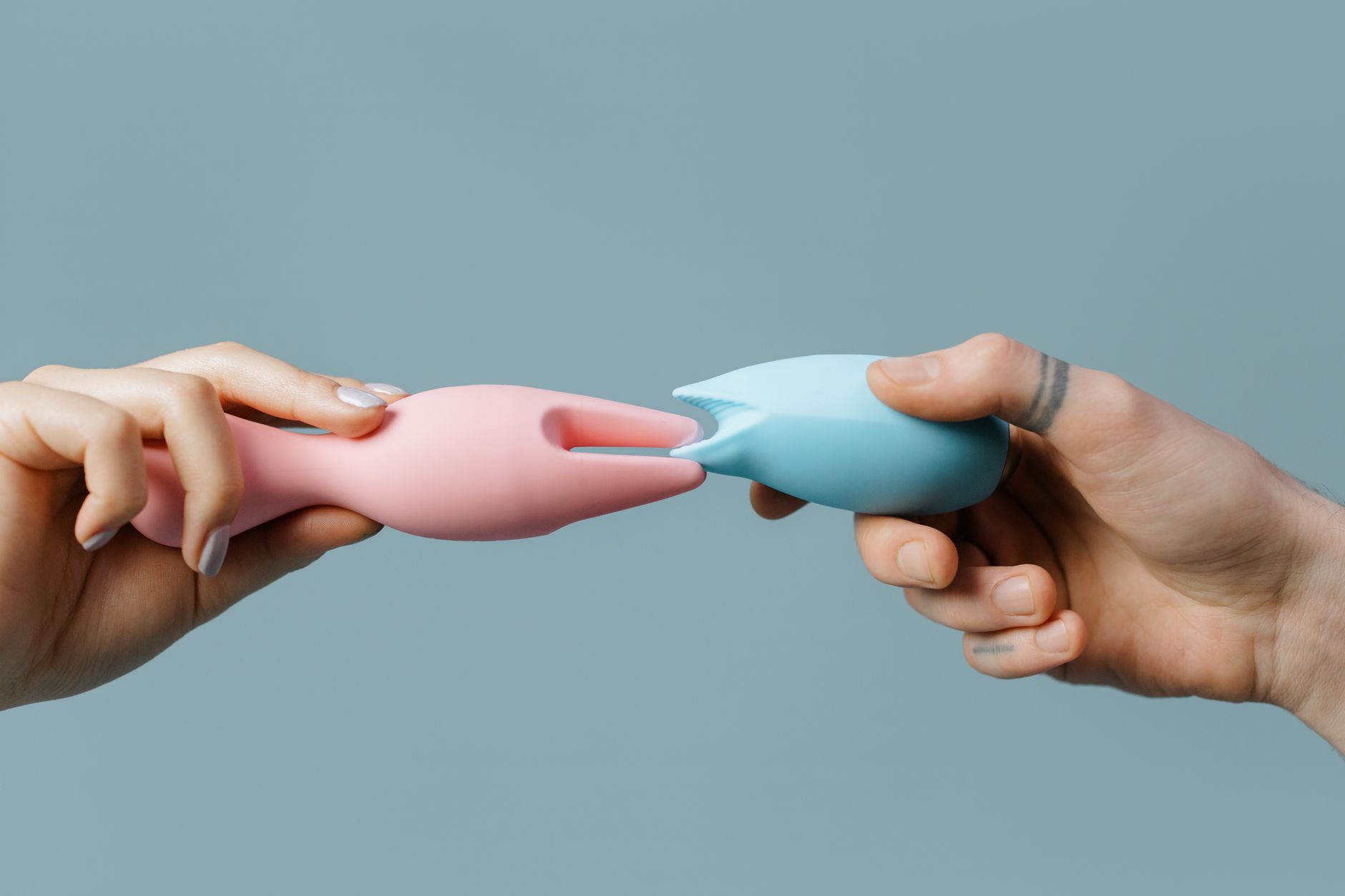
Let's talk about the performance trap
You know the feeling. Your partner is waiting. You're supposed to be "in the mood." The expectation hangs in the air like humidity before a storm. And suddenly, your body becomes a problem you have to solve instead of a source of pleasure. Performance pressure kills arousal faster than anything else I see in my practice.
Here's what happens neurologically: when you're anxious about orgasming (or being orgasmic enough, quickly enough, loudly enough), your sympathetic nervous system activates. That's your fight-or-flight response. Blood flow redirects away from your genitals and toward your muscles. Your arousal literally shuts down. The harder you try, the more impossible it becomes. It's not broken. It's biology working against you.
The fix isn't willpower. It's permission.
Why lemon vibrators change the equation
A lemon clitoral vibrator works differently than your hand or a partner's touch because it removes ambiguity from the equation. When you're using a lemon vibrator, you're not performing for anyone. You're not waiting to see if you're "responding correctly." You're engaging with sensation on your own terms, at your own pace.
The suction mechanism on devices like the Lem works with your body's natural response, not against it. You don't have to work to create arousal. The gentle, consistent stimulation does that work for you. That shift from "I need to make this happen" to "I'm letting this happen" is everything.
When pleasure stops being a performance metric and becomes an actual experience, arousal returns. Not because you're trying harder. Because you've finally stopped trying.
The mental reset you need first
Before you touch a lemon vibrator, you need to change the conversation in your head. I'm serious about this. The device won't fix a mindset problem on its own.
Here's what you tell yourself: "This is mine. Not for anyone else's satisfaction. Not to prove anything. Just for the sensation of being alive in my body." That distinction matters wildly. When your pleasure is the only metric, when there's no audience and no scoreboard, your nervous system relaxes.
If you're with a partner, this is the conversation you have with them too. "I need some time to explore what actually feels good to me, without thinking about what you need." A partner worth keeping will get this immediately. They might even appreciate that you're taking responsibility for your own pleasure instead of expecting them to guess.
Using a lemon vibrator without the audience
Start alone. Not because partnered sex is bad, but because your nervous system needs to relearn that pleasure doesn't require performance.
Set 20 minutes aside when you won't be interrupted. Not an hour. Not a "romantic evening." Just 20 minutes, phone silenced, door locked. The constraint actually helps because there's less pressure to "make it count."
Start with the vibrator at a lower intensity setting. A lot of people think they need to jump to the highest setting, but that's old performance thinking. The point here is sensation, not intensity. You're learning what your body actually feels like when you're not anxious. That sensation might be subtle. Let it be subtle.
Move the vibrator around. Explore. Notice what patterns feel interesting versus what feels rote. You're collecting data about your own body, not working toward a finish line. Some sessions might end in orgasm. Some might not. Both are fine. The point is presence, not outcome.
When your partner is involved
This gets nuanced because the pressure to perform often lives in partnered contexts. Your partner is watching. Waiting for signs of arousal. Maybe they're anxious too, worried they're not doing it right.
If you're using a lemon vibrator with a partner, separate the roles. You're in charge of your sensation. They're not directing. They're present, but they're not managing your pleasure. This is a major distinction. A partner can hold space without performing.
You might say something like, "I want to use this while we're together, but I need you to just be here. Not trying to orchestrate anything. Just present." Some partners will feel sidelined by this. That's information. But a partner who can sit with your autonomy while staying connected is a partner who actually understands intimacy.
The lemon vibrator becomes a bridge, not a replacement. It lets you access pleasure independently while maintaining connection. That's the win.
The pleasure-without-performance rhythm
Once you've had a few solo sessions, you'll notice something: when you're not anxious, arousal actually builds naturally. The lemon vibrator amplifies that response, but it doesn't create it.
Start incorporating it into partnered sex, but on your timeline. Not when they initiate. When you're already aroused and you want to deepen that. The vibrator becomes a tool you use, not a crutch you need. That's the shift.
You might notice that orgasm comes faster, or feels different, or doesn't happen at all. All of that is normal. What matters is that you're experiencing pleasure without the running commentary about whether you're doing it "right." That internal silence is worth more than any orgasm manufactured under pressure.
When the performance anxiety has deeper roots
Sometimes the pressure to perform isn't just about sex. It's about everything. You feel like you have to earn your place. Prove your worth. Be perfect. That dynamic will follow you into the bedroom.
If this resonates, a lemon vibrator can be part of the answer, but not the whole answer. The bigger work is learning that your pleasure matters simply because you exist, not because you earn it. That might mean talking to a therapist. It might mean having some hard conversations with your partner about what you need from them emotionally. The vibrator is a tool, not a fix for everything.
But here's what I know: when you use a lemon vibrator in the context of genuine self-permission, something shifts. You start remembering that your body is yours. That sensation is a right, not a reward. That you deserve pleasure just for the sake of pleasure.
That's where the real healing happens.
People also ask
Can a lemon vibrator actually help if I'm too anxious to orgasm?
Yes, but indirectly. The vibrator itself won't eliminate anxiety, but using it in a low-pressure context can help your nervous system relearn what relaxation feels like during arousal. When you're alone, exploring sensation without an outcome goal, your body slowly stops bracing itself. That's the foundation. Orgasm often follows, but it's not the point. The point is access to pleasure without the accompanying panic.
What if my partner gets jealous or threatened when I use a lemon vibrator?
That's a relationship issue, not a toy issue. A secure partner understands that your autonomy actually strengthens the partnership. You're not choosing the vibrator over them. You're learning to access pleasure independently, which means you're less reliant on them to "fix" you. If a partner responds with jealousy or control, that's worth examining. A lemon clitoral vibrator can help you reclaim your body. Whether the relationship supports that is a separate conversation worth having.
How do I explain to my partner why performance pressure is actually killing our sex life?
Be specific and kind. "When I feel like I need to perform, my body shuts down. It's not about you or anything you're doing wrong. It's about me needing to feel like my pleasure is the point, not a byproduct of pleasing you." Most partners, when they understand this, actually relax too. The performance anxiety isn't just yours. They're often carrying the burden of thinking they need to "make" you aroused. When you take that responsibility, everyone breathes easier.
Is using a lemon vibrator alone considered "enough" if my partner wants partnered sex?
Not if you want partnership too. But using a vibrator alone is absolutely essential groundwork. You're learning your own body without external pressure. Once you understand what genuine, pressure-free arousal feels like, you can bring that knowledge back to partnered sex. You become a more confident, present partner because you're not performing. That's better for everyone.
What if I orgasm with a vibrator but can't with my partner?
That's incredibly common and doesn't mean anything is wrong with you or your relationship. Different types of stimulation create different responses. A lemon vibrator provides consistent, focused sensation. Your partner provides something different entirely. Some people need both. Some people are fine with one. The goal isn't to match every experience across every context. The goal is to have pleasure available to you in whatever form actually works for your body.
How long does it usually take for performance anxiety to ease?
It depends on how deeply rooted it is and what caused it in the first place. Some people feel a shift after a few solo sessions with a lemon vibrator. Others need weeks or months of consistent, pressure-free exploration. Be patient with yourself. You didn't develop performance anxiety overnight. Unlearning it takes time. The fact that you're aware of it and working on it is already the first major step.
The bottom line
Performance pressure is real, it's neurological, and it's absolutely solvable. A lemon vibrator can be part of that solution because it creates a context where pleasure exists for its own sake, not as a metric to achieve or a favor to grant. When you use it to reclaim your body as your own, something shifts. Not just in sex, but in how you relate to your own desires more broadly.
You deserve pleasure. Not because you earn it or perform well enough or satisfy someone else first. Just because you exist. Start there.
If you're ready to explore this on your own terms, that's what matters. And if you need help navigating the relational pieces with a partner, I'm here. Reach out at /contact to talk through what you're experiencing.